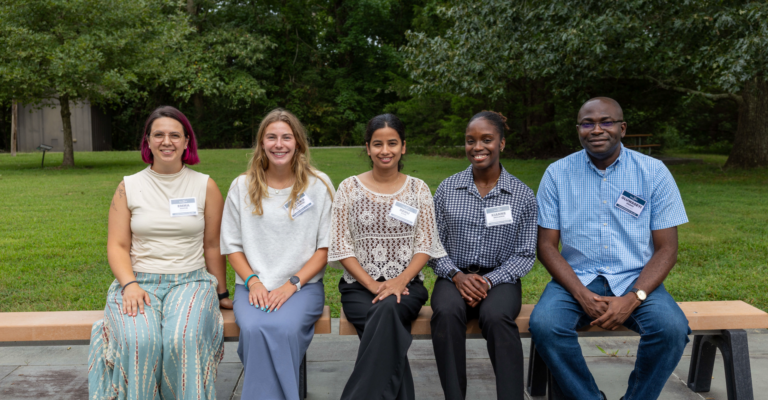
Virginia Sea Grant is pleased to announce the 15 recipients of the 2026 Graduate Fellowship. These graduate students from across the Commonwealth are addressing important marine and coastal challenges. Through collaboration with academic and professional mentors, fellows will expand the reach of their research to coastal communities. They will also receive professional development opportunities through the fellowship that will prepare them for future opportunities in the field.
Meet the 2026 cohort below and learn more about how their research will benefit the commonwealth’s coastal communities.
Isabelle Danforth is a Ph.D. student at William & Mary’s Batten School & VIMS studying the impact of viruses on harmful algal bloom (HAB) dynamics in the Chesapeake Bay. Danforth will use the data collected on how viruses impact HABs and collaborate with her professional mentor, Todd Egerton at the Virginia Department of Health, to improve the accuracy of model-based HAB predictions. She will connect her research to local classrooms through a hands-on lab activity, a lesson plan of which will be developed through the VA SEA program.
Julia Davis is a Ph.D. student in the School of Engineering and Applied Science at the University of Virginia, studying how marsh migration impacts wetland extent and composition. She will collaborate with stakeholders such as Wetlands Watch, Coastal Zone Management Program, William & Mary’s Batten School & VIMS, and local and regional planners to ensure the research is addressing practitioner needs. Davis’ professional mentors, Mary-Carson Stiff from Wetlands Watch and Molly Mitchell from the Batten School & VIMS, will help facilitate this engagement.
Emily Echevarria is a Ph.D. student at William & Mary’s Batten School & VIMS, studying how sandbar sharks use the Chesapeake Bay and coastal lagoons of Virginia’s Eastern Shore as nursery habitats. Echevarria’s research will help better understand how environmental changes impact sandbar sharks, which can serve as an indicator of broader ecological stress in Virginia’s estuarine environments. She will develop various science communication products based on her research with the help of her professional mentor, Kristen Smith, with the Atlantic White Shark Conservancy.
Paola Granados is an Environmental Sciences Ph.D. student at the University of Virginia studying carbon fluxes from salt marsh tidal creeks. With guidance from her professional mentor, Sofia Barboza with the Hispanic Access Foundation, Granados will make bilingual (English and Spanish) outreach materials based on her work with salt marshes. The created materials will communicate the importance of these habitats and the ecosystem services they provide to the Eastern Shore region and its communities.
Madison Griffin is a Ph.D. student at William & Mary’s Batten School & VIMS, studying the ecosystem health and climate resilience of oyster reefs in the Chesapeake Bay using spatiotemporal models. Throughout model development, Griffin will work with her professional mentor, James Wesson, with the Virginia Marine Resources Commission, and share findings at Shellfish Management Advisory Committee meetings. Griffin will also participate in mentorship experiences to encourage local youth to explore pathways into marine science and data science.
Nivedita Kamaraj is a Geosciences Ph.D. student at Virginia Tech, assessing submerged aquatic vegetation (SAV) biodiversity at different salinity zones of the Chesapeake Bay using remote sensing. Kamaraj will engage with participatory events such as the Chesapeake Water Watch or Chesapeake Bay SAV watchers program to meet with citizen science volunteers and collect field data on SAV occurrence. As her research progresses, she will receive guidance on remote sensing methodologies from her professional mentor Ashutosh Tiwari, with the Texas A&M AgriLife Research & Extension Center.
Eric Liu is a Ph.D. student at Old Dominion University researching seed collection and propagation methods for salt marsh cordgrass (Spartina alterniflora). Liu’s research will analyze various ecological factors that could affect the life cycle or physical characteristics of this cordgrass. He will work with his professional mentor, Luísa Black Ellis, with the Elizabeth River Project, to use these findings and improve restoration practices in salt marsh systems. Liu will also create a public-facing guidebook on salt marsh cordgrass to educate growers and prospective growers on best practices for collecting and growing native seed.
Novia Mann is a Ph.D. student at William & Mary’s Batten School & VIMS, studying how tidal marsh systems respond to changes in alkalinity production, and how well these systems can resist rapid changes in pH. Mann will take the data collected and work to incorporate carbonate system measurements into a long-term water quality monitoring program run by the Chesapeake Bay National Estuarine Research Reserve in Virginia (CBNERR-VA). She will receive guidance from her professional mentor, Scott Lerberg at CBNERR-VA, to develop these parameters that will ultimately help manage coastal acidification in tidal marsh systems.
Linda Miranda is an M.S. student at Hampton University, evaluating the ecological performance and structural resilience of using basalt oyster shell bags for sustainable shoreline restoration. She will assess the ecological function and structural integrity of basalt oyster bags as a sustainable alternative to plastic mesh bags. Miranda plans to co-develop a living shoreline course at Hampton University with guidance from her professional mentor, Kati Grigsby, with the Chesapeake Bay Foundation.
Riley Moreau is an Environmental Science and Policy Ph.D. student at George Mason University studying how non-native predatory fish impact tidal freshwater nurseries. The freshwater tributaries of the Potomac River serve as nursery habitat for various species that draw in local anglers, so Moreau’s research will help better understand how invasive fish species are impacting valuable native species. Moreau also plans to host outreach events for local fishing groups and interested citizens, as well as deliver presentations to state agencies with help from his professional mentor, John Odenkirk, with the Virginia Department of Wildlife Resources.
Emily Ogawa is an Ecological Sciences Ph.D. student at Old Dominion University studying how and where microplastics accumulate in the Chesapeake Bay. Her research will determine how much microplastic is ingested by organisms and how that ingested microplastic is transferred from one organism to another within an ecosystem. Ogawa plans to engage the public through citizen science initiatives and campaigns with the help of her professional mentor, Christina Trapani, with Clean Virginia Waterways.
Jackie Okao is a Public Policy and Administration Ph.D. student at Virginia Commonwealth University, working to develop policy frameworks to prevent rip current drownings. Okao will be analyzing existing policies in Virginia Beach and identifying opportunities for strengthening prevention efforts, all while navigating the inner workings of the local government with guidance from her professional mentor, Shaun Anderson from Norfolk State University. Okao will also create educational materials about rip currents to distribute digitally and physically at beachside kiosks, hotels, and restaurants.
Ria Salway is an M.S. student at William & Mary’s Batten School & VIMS, studying how ocean acidification and increased temperature impact triploid and diploid oysters. Salway will assess the physiological responses of eastern oyster (Crassostrea virginica) seed to determine how growth and survival are impacted by temperature and acidification. She will create communication materials for oyster farmers and hatcheries based on these findings, receiving guidance from her professional mentor, Lauren Huey at Green Fin Studio.
Lihong Yang is a Biological System Engineering Ph.D. student at Virginia Tech who is working to create an AI-enabled fish farming system that monitors water quality, fish behavior, and welfare for producers and farm managers. The system will monitor the fish and gather the data into an open-source platform for storage and visualization, providing real-time data for decision-making. Once this monitoring system is complete, she will work with her professional mentor, Jesse Trushenski at Riverence, to communicate the relevance of the system to aquaculture producers and extension specialists, and lead demonstrations on how to use it to improve aquaculture operations.
Zanko Zandsalimi is a Civil and Environmental Engineering Ph.D. student at the University of Virginia, working to quantify the economic value of flood monitoring and early warning systems. He will do this by developing an economic Value-of-Information (VoI) framework that looks at how information alters decision-making before and during flood response. Zandsalimi will translate his findings into a set of decision-support resources with guidance from his professional mentor, Sarah Chappel, with the Virginia Department of Emergency Management.