VA SEA recognized as a premiere science education program
Celebration of the award aligned with the 9th annual Lesson Plan Expo
Days before hosting their ninth annual Lesson Plan Expo, organizers at the Virginia Science & Educators Alliance (VA SEA) learned some exciting news: their dedicated effort to improve K-12 marine science education in the commonwealth had not merely been noticed; it was being awarded. The Virginia Mathematics and Science Coalition (VMSC) has bestowed a 2026 Programs that Work Award to VA SEA, recognizing the initiative as an exemplary program making a positive impact on student and teacher learning.
VA SEA is administered as a partnership between William & Mary’s Batten School & VIMS Office of Outreach & Engagement and Virginia Sea Grant, with generous support from the MacWhorter family via the Virginia Scientists & Educators Alliance Fund (6129).
“We are thrilled to receive the Programs That Work Award,” said Sarah Nuss Ph.D. ’24, director of outreach & engagement at the Batten School & VIMS. “I believe what stood out most was VA SEA’s strong, demonstrated impact and global reach. To date, our lesson plans have been downloaded more than 300,000 times across 172 countries. Our program’s dual focus is also unique: supporting graduate student training while building meaningful partnerships with K-12 teachers. It’s a true win-win scenario.”
Through VA SEA, marine science graduate students develop lesson plans for K-12 classrooms, beginning with fall workshops that train graduate students in pedagogy and science communication. Students then develop initial lesson plans under the guidance of VA SEA organizers before participating in a January conference, newly introduced in 2026, that connects them with teachers who provided direct feedback. The program culminates with the spring Lesson Plan Expo, a public event showcasing the finalized plans which is attended by educators from across the commonwealth.
“To date, our lesson plans have been downloaded more than 300,000 times across 172 countries,” Nuss said.
Dawn Sherwood, who teaches A.P. environmental science and dual enrollment college biology at Highland Springs High School, has attended every expo since its inception.
“It’s definitely worth it,” she said of making the drive from Richmond to the Batten School & VIMS’ Gloucester Point campus. “At the expo, I get to engage with the activity, talk to the person who created it and learn how it works instead of just reading a lesson plan and trying to figure it out on my own. It’s great to be able to ask the graduate students questions and pick their brains about the lesson and how I can incorporate it.”
That sentiment was shared by Alexandria Duscher, a research methods instructor at the Governor’s School for Science & Technology in Hampton.
“I attend for unique, relatable materials that can help teach our students how to undergo research and analyze data,” she said. “Our students really enjoy when we bring these hands-on activities back versus having a lecture. It’s fantastic.”
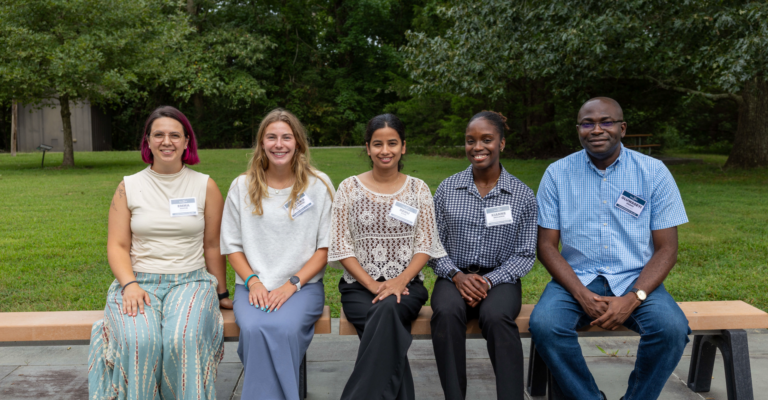
This year’s expo was held on April 23 and featured 10 new lesson plans on topics ranging from museum-style sample collection to the effects of waste management on microplastic pollution. Educators from around the state perused the expo to experience lesson plan demonstrations, inspect materials and speak with the graduate students, emphasizing the collaborative nature of the entire program.
“One of the most significant impacts I’ve observed over the past nine years is the strong and growing appreciation graduate students have for the skills they gain through VA SEA,” said Nuss, describing how the collaboration benefits participating graduate students. “Interest in the program — and in outreach and education more broadly — has steadily increased, which I believe reflects students’ recognition of how valuable these science communication skills are, both in their academic work and as they transition into the workforce.”
One of those participants was Camille Wilson, a masters-bypass student at the Batten School of Coastal & Marine Sciences & VIMS. Her lesson plan on identifying ideal conditions for seagrass restoration was one of two projects selected by VA SEA to be further presented at a pair of upcoming conferences, the National Marine Educators Association Conference and the Virginia Association of Science Teachers Professional Development Institute.
Wilson says participating in VA SEA has “one hundred percent” helped her better understand and communicate her own graduate research.
“Being deep in the academic mindset, we can use a lot of jargon, so it’s been helpful to take a step back and think about how you should communicate to someone trying to understand this concept for the first time,” she said. “It’s been rewarding, and I’ve learned a lot. They’ve set up the program really well, with plenty of opportunities to get feedback along the way. Now, being here at the expo, it’s fulfilling to show my finished lesson.”
“At the expo, I get to engage with the activity, talk to the person who created it and learn how it works instead of just reading a lesson plan and trying to figure it out on my own,” Sherwood said.
Shyane Masters, also a Batten School & VIMS masters-bypass student, similarly found the program rigorous and beneficial. Her lesson plan on identifying blood-stress biomarkers in sharks directly benefited from the inaugural lesson plan conference in January.
“It was so useful to see things from a teacher’s perspective and work out all the little kinks that might not have worked in a classroom,” she said. “The whole program has been really rewarding, because it’s been really challenging. I don’t think a lot of people realize how complicated it is to put a single lesson plan together. It’s a lot of thought over many hours and days. I give all the teachers all the props, because it’s difficult.”
After the expo, lesson plans are publicly available to download for free, all in the spirit of invigorating marine science education in Virginia and beyond. With the conclusion of the 2026 Lesson Plan Expo, there are now 97 lesson plans available.
Inspired by that impact, Sherwood had a departing piece of advice for her fellow educators before she began her return drive to Richmond.
“Go online and look at the lessons. Everything you need is there, and there are ways to contact the researcher, so it’s a one-stop shop,” she said. “If you couldn’t attend the expo, take a look at the lessons online — and then plan to come next year!”
Photos by Bayleigh Albert | Virginia Sea Grant
Story by Ethan Smith | William & Mary’s Batten School & VIMS
Republished with Permission on May 7, 2026
“Being deep in the academic mindset, we can use a lot of jargon, so it’s been helpful to take a step back and think about how you should communicate to someone trying to understand this concept for the first time,” Wilson said.