From Coastal Research to Coastal Policy
2026 Sea Grant-Chesapeake Bay Commission Fellow Announced
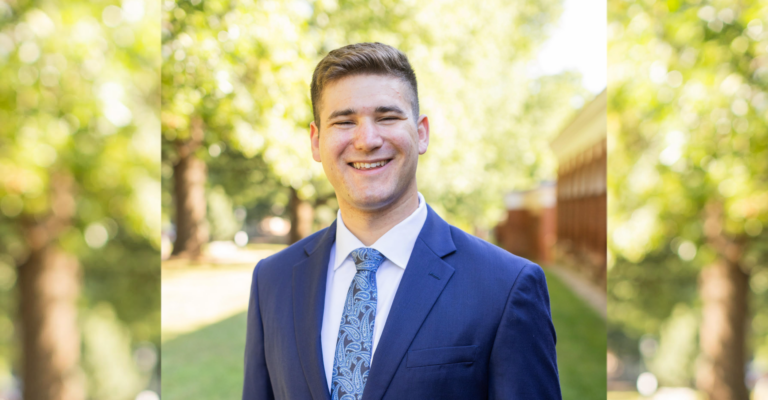
Megan Beever, a Ph.D. candidate at Virginia Tech, has been selected as the 2026 Sea Grant-Chesapeake Bay Commission Fellow. The Sea Grant-Chesapeake Bay Commission Fellowship is an annual competitive fellowship program that places one graduate or post-graduate student with the office of the Chesapeake Bay Commission, where they contribute to real-world policy work affecting the communities and watersheds of the Chesapeake Bay. The fellowship is co-sponsored by the Chesapeake Bay Commission and the Virginia, Maryland, and Pennsylvania Sea Grant College Programs.
“The Commission sits in a unique policy space, responsible for supporting the restoration efforts of three states, serving as a liaison to Congress on Bay-related issues, and providing leadership as a signatory to the Chesapeake Bay Watershed Agreement,” said Anna Killius, Chesapeake Bay Commission executive director and 2014 Sea Grant Knauss Marine Policy Fellow. “Our fellows have the opportunity to experience what science-based policy looks like in all three of those spheres while maintaining a collegial, collaborative, and bipartisan community.”
Beever’s doctoral research focuses on how barrier islands are shaped by waves and tides. She is developing a method for dune identification and analyzing how barrier island characteristics change over time. As a previous Virginia Sea Grant Graduate Fellow, she worked with her professional mentor Jarrell Smith at the U.S. Army Engineer Research and Development Center, analyzing regional trends of barrier island characteristics and numerically modeling barrier island breaching during hurricanes. Her research provides coastal managers and communities with information to support informed management decisions.
“I noticed that I was more focused on how the science could be used than on the next research question, and I slowly realized that I might fit into the science policy space,” said Beever. “That led me to take policy-related classes and attend workshops to learn more about science policy and learn where I could fit within it.”
That intersection of environmental science and community impact is what drew Beever to coastal engineering and inspired her to pursue the Sea Grant-Chesapeake Bay Commission Fellowship.
“The Chesapeake Bay Commission felt like the perfect fit for me to explore science policy,” said Beever. “Being a bipartisan and tri-state body, the Commission enables me to see how the regional goal of restoring the Chesapeake Bay and its watershed is implemented across federal, regional, and local levels.”
“I am especially excited to gain a real understanding of how science shapes legislative decisions, build connections with people working in science policy, and to find where my skills and interests fit within the science policy world,” said Beever.
“Expanding this collaboration to include Maryland and Pennsylvania will not only unlock new opportunities for Megan but will grow the Commission’s relationships with each of these institutions for the benefit of our states and our watershed.” said Killius.
The Sea Grant-Chesapeake Bay Commission Fellowship was launched in 2025 as a partnership between Virginia Sea Grant and the Chesapeake Bay Commission. After a successful inaugural year, Maryland Sea Grant and Pennsylvania Sea Grant contributed funding to the effort, expanding it into a regional fellowship that reflects the Commission’s tri-state jurisdiction and cooperation between mid-Atlantic regional Sea Grant programs focused on improving the health of the Chesapeake Bay and its watershed. The broader collaboration provides fellows with expanded opportunities to engage in science policy, while strengthening connections between the Sea Grant programs and the Chesapeake Bay Commission.
“As a tri-state Commission, it was important to reach applicants and provide professional development opportunities representative of all three jurisdictions,” said Killius. “Expanding this collaboration to include Maryland and Pennsylvania will not only unlock new opportunities for Megan but will grow the Commission’s relationships with each of these institutions for the benefit of our states and our watershed.”
For Beever, gaining firsthand experience in the policymaking process is one of the fellowship’s biggest draws. Having actively sought opportunities to explore science policy throughout graduate school, she is eager to apply her research background in a legislative setting and better understand how science informs decisions that affect the Chesapeake Bay and the communities that rely on it.
“I am especially excited to gain a real understanding of how science shapes legislative decisions, build connections with people working in science policy, and to find where my skills and interests fit within the science policy world,” said Beever.
Photos provided by Megan Beever
Story by Bayleigh Albert | Virginia Sea Grant
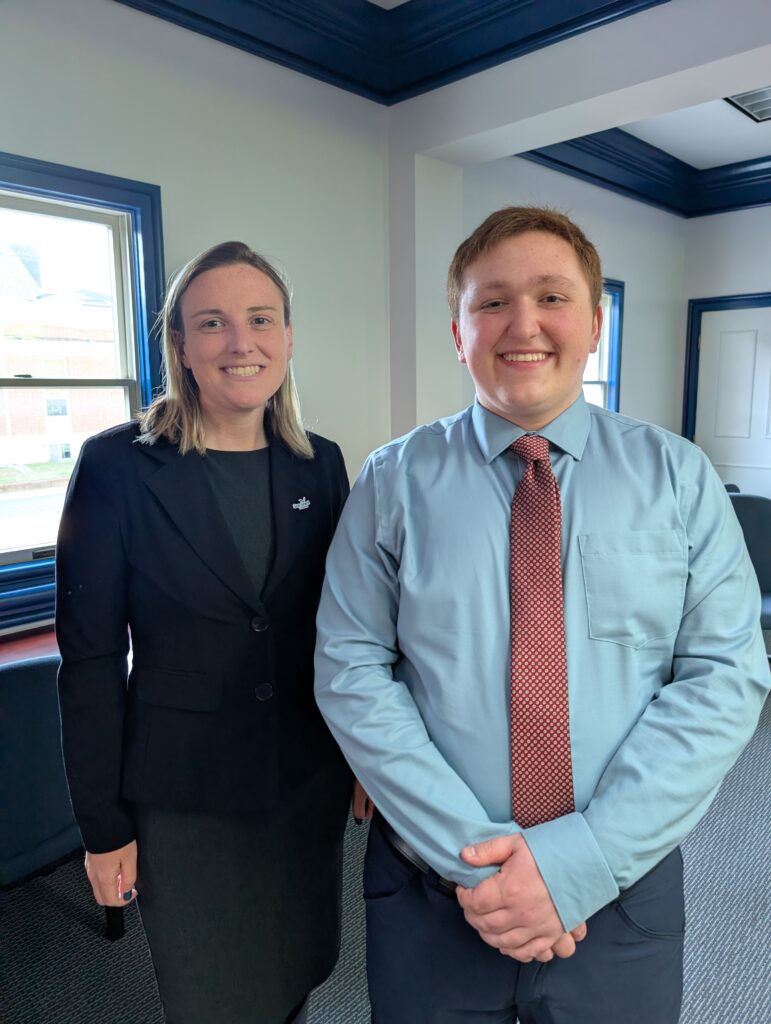
Chesapeake Bay Commission Fellow Greg O’Connell (left), Chesapeake Bay Commission Executive Director Anna Killius (right).
Greg O'Connell reflects on Chesapeake Bay Commission Fellowship
After a year immersed in the world of science policy, Greg O’Connell has completed his Chesapeake Bay Commission Fellowship. Offered in partnership with Virginia Sea Grant, the fellowship provides graduate students with the opportunity to work at the intersection of science and policy while supporting efforts to protect and restore the Chesapeake Bay.
“The Chesapeake Bay Commission began exploring the opportunity to host a year-long graduate fellowship because of a belief in and commitment to growing the next generation of watershed leaders,” said Anna Killius, executive director of the Chesapeake Bay Commission and 2014 Knauss Fellow. “Our members felt strongly that the Commission should play a more active role in providing a pipeline for students interested in the intersection of Chesapeake Bay science and policy. And Greg’s fantastic contributions to the Commission’s work during our pilot year proved that the fellowship can be a great benefit to our members.”
Supporting Chesapeake Bay Policy
As a Commission policy fellow, O’Connell played an active role in tracking Chesapeake Bay-related legislation. His work involved monitoring bills introduced in Virginia, Maryland, and Pennsylvania, following their progress through committee hearings and tracking whether the bills passed.
Throughout the fellowship, O’Connell developed a deeper understanding of how scientific information informs environmental policy, along with how to communicate that information to audiences without technical expertise. Whether creating infographics, fact sheets, or policy summaries, O’Connell learned the importance of translating complex scientific concepts into clear, accessible information that helps policymakers and the public make informed decisions.
“It was a great work environment, and I’ve really enjoyed working there,” O’Connell said while reflecting on his experience as a Commission fellow. “I got to go to Richmond for the General Assembly, to go lobby for bills, and visit Capitol Hill.”
“Greg’s research on local perspectives on watershed modeling didn’t just inform the room; it sparked real dialogue about closing the gap between state models and on-the-ground realities,” said Lisa Eddy.
Beyond the Boardroom
The Chesapeake Bay Commission’s work extends far beyond legislative offices. Throughout the year, O’Connell helped coordinate the Commission’s quarterly meetings, which bring together legislators from across the Chesapeake Bay watershed to discuss regional environmental priorities.
Many of these meetings included site visits that allowed policymakers to see firsthand how legislation influences communities and ecosystems. From dairy farms bordering streams to wastewater treatment facilities and acid mine drainage sites, these field visits allowed legislators to see successful restoration efforts as well as ongoing environmental challenges. By connecting policy discussions with real-world examples, the Commission helps decision-makers better understand where future policy can support improvements to water quality and watershed health.
“When we’re talking about a best management practice to clean up the Chesapeake Bay, it’s not a vague thing, it’s this specific thing right here,” O’Connell said. “And then you get to go walk through it and talk to the people that manage it and show legislators that.”
Improving Chesapeake Bay Modeling
For his fellowship policy project, O’Connell leveraged his background in political analytics and statistical modeling to examine how the Chesapeake Bay Watershed Model influences local planning and the implementation of pollution reduction practices.
He began by working with modelers from the Chesapeake Bay Program to better understand how watershed models are developed and how they inform policy decisions. O’Connell then interviewed state and local stakeholders to explore how scientists and policymakers can more effectively communicate throughout the modeling process and ensure models accurately represent changing environmental conditions.
“… a big model is going to make a lot of assumptions about the way that the world works, and those assumptions might not reflect reality on the ground,” said O’Connell.
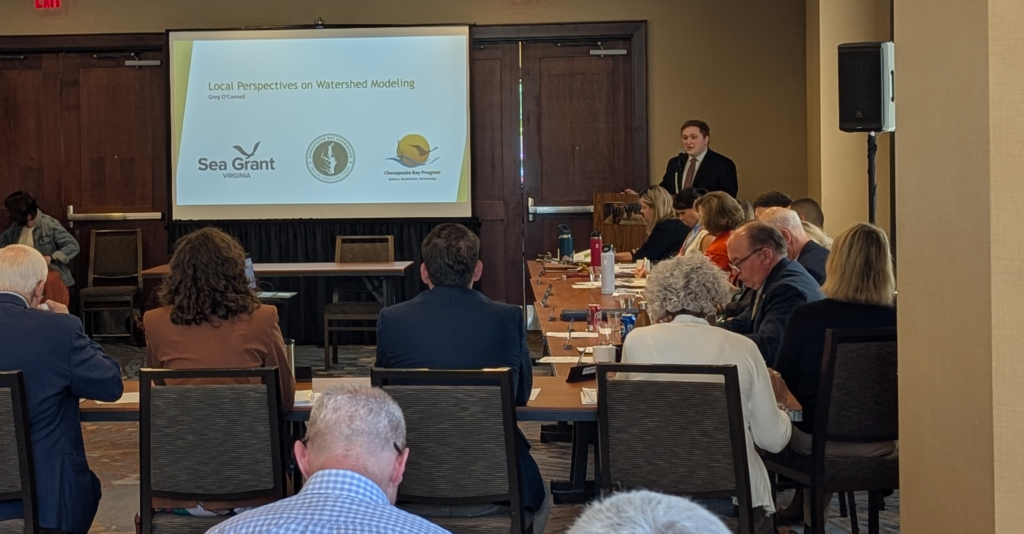
O’Connell’s work culminated in a written report identifying challenges associated with developing scientifically robust, up-to-date watershed models and offering recommendations to strengthen collaboration between scientists and policymakers. He presented his findings at the Chesapeake Bay Commission’s quarterly meeting in May 2026.
“Seeing Greg stand before the Chesapeake Bay Commission in Annapolis and field questions from policymakers like a seasoned pro was a proud moment for me and for our program,” said Lisa Eddy, Virginia Sea Grant’s competitive research and education coordinator. “His research on local perspectives on watershed modeling didn’t just inform the room; it sparked real dialogue about closing the gap between state models and on-the-ground realities. His presentation was also a great example of why the Virginia Sea Grant–Chesapeake Bay Commission partnership matters: it gives talented fellows and their research a seat at the table where decisions are being made.”
Photos by Lisa Eddy | Virginia Sea Grant
Story by Bayleigh Albert | Virginia Sea Grant
Stories published August 4, 2026.